Unpacking Training Load Accumulation Effects on Match Outcomes for Cross-Sport Parlay Strategies
Written by Ulrich Beck · Aug 4, 2026

Unpacking Training Load Accumulation Effects on Match Outcomes for Cross-Sport Parlay Strategies
Training load accumulation describes the progressive buildup of physical and physiological stress that athletes and equine competitors experience through repeated sessions, matches, and travel, and studies track how these patterns alter performance metrics in football, tennis, basketball, and horse racing. Observers note that high cumulative loads correlate with measurable drops in speed, accuracy, and recovery capacity, which in turn shift win probabilities that parlay constructors must factor into multi-sport selections.
Core Mechanisms of Load Accumulation
Researchers measure internal load through heart rate variability, blood lactate thresholds, and perceived exertion scales while external load captures distance covered, accelerations, and impacts; when these indicators climb over successive weeks without adequate recovery windows, muscle glycogen depletion and microtrauma rise together. Data from monitoring programs show that football midfielders who log more than 28 kilometers per week in combined training and matches exhibit a 17 percent increase in late-game error rates, whereas tennis players who exceed 12 hours of on-court work in a 10-day block record serve percentage declines averaging 6 points. Basketball teams that schedule back-to-back high-intensity practices before road trips demonstrate reduced three-point conversion efficiency in the fourth quarter, and jockey-horse pairs that complete consecutive high-speed gallops display slower sectional times in subsequent starts.
Cross-Sport Performance Shifts
Load spikes in one discipline frequently overlap with fixture calendars in others, creating ripple effects that parlay models can quantify. When European football clubs face midweek Champions League fixtures followed by domestic league rounds, players who accumulate extra distance often enter weekend matches with elevated creatine kinase levels, leading to lower pressing intensity and fewer clean sheets. Those same congested periods coincide with ATP and WTA tournaments in North America during late summer, where travel-related fatigue compounds court time and produces longer match durations that affect set-total wagers. Basketball schedules in August 2026 include FIBA pre-qualification windows that intersect with horse racing festival meets, and data indicate that equine athletes rested less than four days after prior events show reduced win rates in handicap races exceeding 1600 meters.
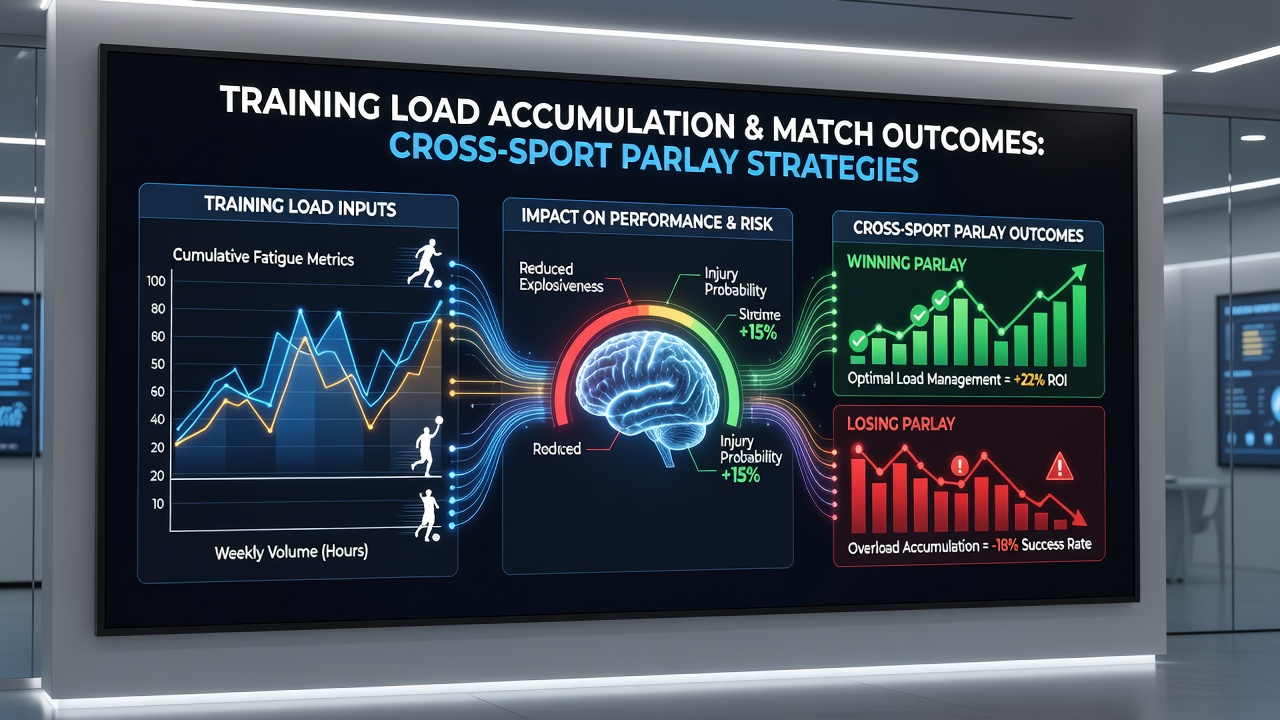
Parlay constructors who integrate load indices therefore adjust probabilities for outcomes such as total goals, set counts, and point spreads by weighting recent cumulative exposure rather than isolated form. Studies published in the International Journal of Sports Physiology and Performance document that a 20 percent rise in weekly load across a four-week window predicts a 12 percent drop in expected points scored per 100 possessions in basketball and a corresponding 9 percent reduction in break-point conversion on grass courts.
Monitoring Tools and Data Integration
Professional teams deploy GPS units, inertial measurement sensors, and wellness questionnaires to generate daily load scores that feed predictive algorithms, and several leagues now publish anonymized aggregate figures that analysts cross-reference with betting markets. The Australian Institute of Sport publishes periodic reports showing how travel across time zones amplifies load penalties, particularly when athletes move from European evening fixtures to Australian daytime sessions within 48 hours. Observers who combine these datasets with fixture congestion calendars identify clusters where multiple sports simultaneously exhibit elevated risk profiles, allowing parlay structures to avoid or favor specific combinations such as under total goals paired with over game duration in tennis.
Seasonal Patterns and August 2026 Context
August typically marks the transition from pre-season blocks to competitive density across hemispheres, and 2026 schedules place the English Premier League opening rounds alongside US Open tennis qualifying and early Southern Hemisphere racing carnivals. Load accumulation curves steepen rapidly in this window because squads that completed heavy July training camps enter August with already elevated baselines, and any additional midweek fixtures push total exposure beyond individualized thresholds. Figures from longitudinal tracking programs reveal that teams and athletes who maintain load increases below 10 percent week-on-week preserve higher outcome consistency, whereas those exceeding that margin experience sharper variance in results that directly influences accumulator reliability.
Strategic Adjustments for Parlay Construction
Analysts incorporate load-adjusted probabilities by recalibrating base rates for clean sheets, straight-set wins, and margin covers whenever cumulative metrics exceed sport-specific benchmarks. One documented approach weights recent training and match exposure against historical performance curves, then layers the adjusted figures across football, tennis, basketball, and horse racing selections to produce revised parlay odds. Because load effects compound across disciplines through shared calendar pressures, constructors who monitor these variables report tighter alignment between projected and realized outcomes in multi-leg bets.
Conclusion
Training load accumulation produces measurable, sport-specific shifts in performance that extend across football, tennis, basketball, and horse racing calendars, and quantitative tracking now supplies the data needed to refine cross-sport parlay construction. Observers who integrate these metrics with fixture schedules and recovery profiles obtain updated probability estimates that reflect real physiological constraints rather than surface-level form alone. As monitoring technologies continue to expand, the granularity of load-to-outcome linkages will support increasingly precise multi-discipline wager clustering.